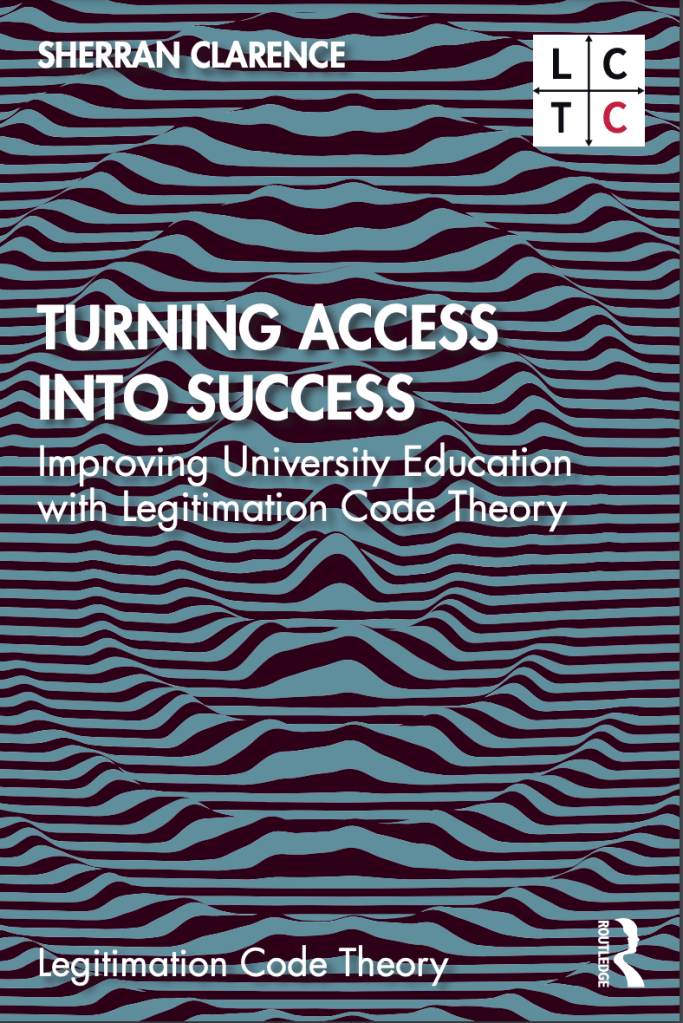
My monograph
ISBN: 9780367335618
More information and table of contents below. You can also listen to me talk about the book here.
Overview
This book is written for educators – university lecturers and academic or educational developers. It fills a gap between theory in its less accessible, day-to-day usability forms and atheoretical ‘tips and tricks’ for teachers. It fills this gap by using a powerful, practical, creative theoretical framework – Legitimation Code Theory or LCT – to analyse five issue or questions that educators across and within many higher education contexts share. The book is part of the LCT series published by Routledge (series editor, Prof Karl Maton, who developed LCT). The book has two main aims: to offer readers accessible, context-based understandings of what the key issues are and how we may understand and contextualise them; and practical, theorised ways of unpacking, making sense of, and addressing these issues in our own classrooms or workspaces. It is intended to be a sourcebook, more than a source of any ‘best practice’: the goal is to inspire, challenge but ultimately support and help educators who want to create more accessible, socially just, and successful learning environments for their students.
Table of Contents
Chapter 1: Context is key. Laying the foundations for ‘better’ teaching practice
Chapter 2: Creating a responsive curriculum: Specializing knowledge and knowers for success
Chapter 3: Can we change the university? Critiquing exclusion in the curriculum
Chapter 4: Enabling cumulative learning: Teaching students to surf waves of meaning
Chapter 5: ‘Show me what you’ve learned’: Guiding cumulative assessment practice
Chapter 6: Learning through reflection: Sustainable feedback and evaluation practices
Chapter 7: Afterword: From access to success

Edited collection of essays on writing centre praxis in South Africa and the US
Co-edited with Dr Laura Dison, Wits University
ISBN: 9781928357544
This book contains a collection of essays theorising writing centre work from a range of critical perspectives, including meta-theory, social realism, Legitimation Code Theory, and democratic theory. Contributors come from a mix of historically advantaged and historically disadvantaged universities across South Africa, and from one university in the United States. The book is based on the premise that writing centres are established student and staff academic support structures in many universities around the world. But, while their work is widely relied upon by students and their lecturers and supervisors, many writing centres still struggle for greater institutional recognition, support and funding. Further, many are at times pushed into working in less theorised or critical ways to secure funding that fits into universities’ larger ‘mission and vision’ statements, which may not necessarily align with writing centres’ missions and visions. Contributors to this collection show, in a range of different essays, how critical the work of writing centres is to teaching, learning and assessment within and across the disciplines. Rather than reflecting only on the work they do within their own ‘four walls’, these contributions reflect on the work writing centre and academic literacy practitioners are doing within the disciplines, with lecturers and with student-writers. This book makes an important contribution to theorising and sharing the diverse work of these important academic support centres.

 How to write a PhD in a hundred steps (or more)